Not All Boundaries Are About Being Able to Say No
On the boundaries you crossed without anyone asking, and what that cost you.
BOUNDARIES
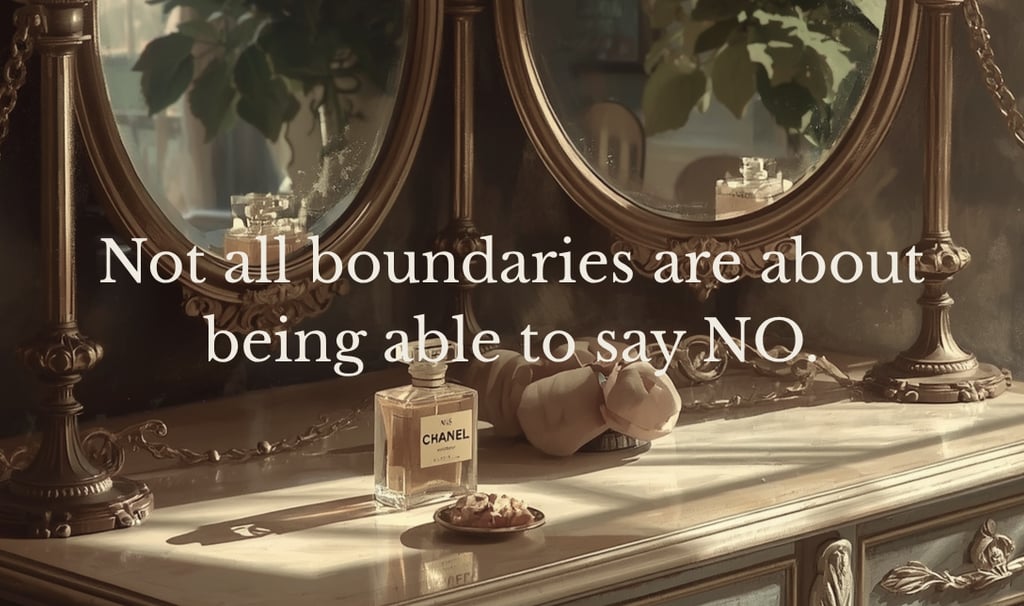
My mother had a bottle of Chanel No 5 that was at least twenty years old. Nearly full. The perfume had turned dark with age, the colour of old tea. She wore it so rarely that the bottle barely emptied over two decades.
She was not saving it for a special occasion. She kept it so carefully that she rarely used it.
She was one in a thousand. Always there for everyone, a genuinely wonderful mother. But she gave so much of herself away that she kept almost nothing back. She kept herself quietly and consistently, tried never to be a burden, asked for very little. I saw her stand up for herself once, at a moment when it was absolutely necessary. That one moment generated enormous respect in me. But it remained the one moment.
I took note of it. I decided I would do things differently.
So I learned from the past and did things differently. Or did I?
I kept chocolate in the cupboard, just for me. Forbidden to be touched by my children. Set aside a good piece of food sometimes, consciously, not to be shared. Small things, only mine, because I wanted to care for myself in a way I had not seen enough of growing up.
But my time and energy were still shared property. I was available to everyone, always. I took things on before anyone asked, because I had decided somewhere along the way that this was simply what it meant to be a good mother. A reliable colleague. A capable woman who held things together without making a fuss.
I remember evenings at the stove, cooking after a full working day, eyes closing mid-stir. I took my husband's energy drinks from the fridge quietly, the small shot bottles, to get through the evening. Slapped myself in the face to stay awake. Made a double espresso. Continued as my children were hungry and my husband was coming home soon.
I went to the doctor more than once. Blood results were fine. Nothing wrong. Just very tired, they said. I thought the problem was me, that I had less physical resilience than other people. I bought a light therapy device. A blue light glasses kit for winter mornings. Read about iron levels and sleep hygiene. Tried each thing carefully.
None of it worked.
Because the problem was not my body. I was crossing my own limits structurally, not because anyone demanded it, but because I had never asked myself where those limits were. And like my mother, I had absorbed a deep and unexamined belief that not being strong and ask for too much was a form of failure.
My mother's word for resilience was: 'Just be strong, keep going, everything will be alright'.
She said it when I was a little girl and struggling and she did not know how to help me. She meant it kindly. She was passing on the only coping strategy she had ever been given. But there is a version of strength that functions as a slow disappearance. The woman who never complains, never asks, never uses her own perfume.
This is the part about boundaries that most advice misses entirely.
Boundaries are not only about saying no when someone asks too much of you. They are also about everything you take on quietly, without a direct request, because you absorbed the belief that this was simply your role. Research on the fawn response, developed through Pete Walker's work on complex trauma, describes one mechanism behind this: when people learn early that accommodating others brings safety, that response becomes automatic. You do not wait to be asked. You anticipate, adjust, pre-empt. You manage the comfort of everyone around you before your own needs even register as real.
And because no one is visibly demanding anything, it does not feel like a boundary problem. It feels like being good at your life. Being the strong one, the capable one, the put together one.
Until the evening your eyes close at the stove.
Is this a real boundary, or am I just asking too much?
There is a question I hear often from women who are beginning to look at this pattern. "Is this a real boundary, or am I just asking too much?"
The women who ask it are almost never asking too much. They have spent years asking too little of themselves and of the people around them. Beginning to notice their own limits reads as selfishness. As ingratitude for a life that, by many measures, looks fine.
Research on self-determination is clear on one thing: there is a difference between giving from choice and giving from fear of what happens if you stop. When you act from fear of disapproval rather than from your own values, you are not being generous. You are running on a deficit that builds quietly over years.
The difference between my mother and me was smaller than I had thought.
The first step is not learning to say no. The first step is seeing what you have been silently saying yes to.
If you want to look honestly at where your own limits sit, there is a free boundary audit on the website that maps this across ten areas of your life. It takes about ten minutes and no one sees your results.
References: Walker, P. (2013). Complex PTSD: From Surviving to Thriving. Azure Coyote. Deci, E.L. & Ryan, R.M. (2000). The "What" and "Why" of Goal Pursuits. Psychological Inquiry, 11(4), 227–268.
Subscribe to my newsletter
Reflections on identity and responsibility
From time to time I write essays about identity, motherhood, responsibility and reconnecting with yourself.
If these themes resonate with you, you are welcome to join the newsletter.