The Gap Between Who You Are and Who You Have Been Presenting
Five dimensions that bring you back to yourself — beneath the roles, the editing and the performance
IDENTITY
There is a particular kind of exhaustion that comes not from doing too much but from being someone slightly other than yourself for too long.
Most women who experience it cannot name it precisely. They are functioning. They are competent. They are showing up reliably for every role they occupy. And they are tired in a way that the workload does not explain.
What is tiring is the editing. The continuous, largely automatic process of calibrating who you present yourself to be in response to what the environment seems to require. The minding of how things will land. The preference softened before it is spoken. The opinion reshaped into a question. The limit not drawn because this is not the moment, and the moment somehow never comes.
This is not dishonesty. It is a pattern that develops, gradually and reasonably, in women who have learned that keeping the peace, the harmony, the relationships, requires a particular kind of self-management. And it is so habitual by the time most women notice it that it no longer registers as editing at all. It feels like personality.
Until someone asks you directly what you want. And the answer takes longer than it should.
The gap between role and self
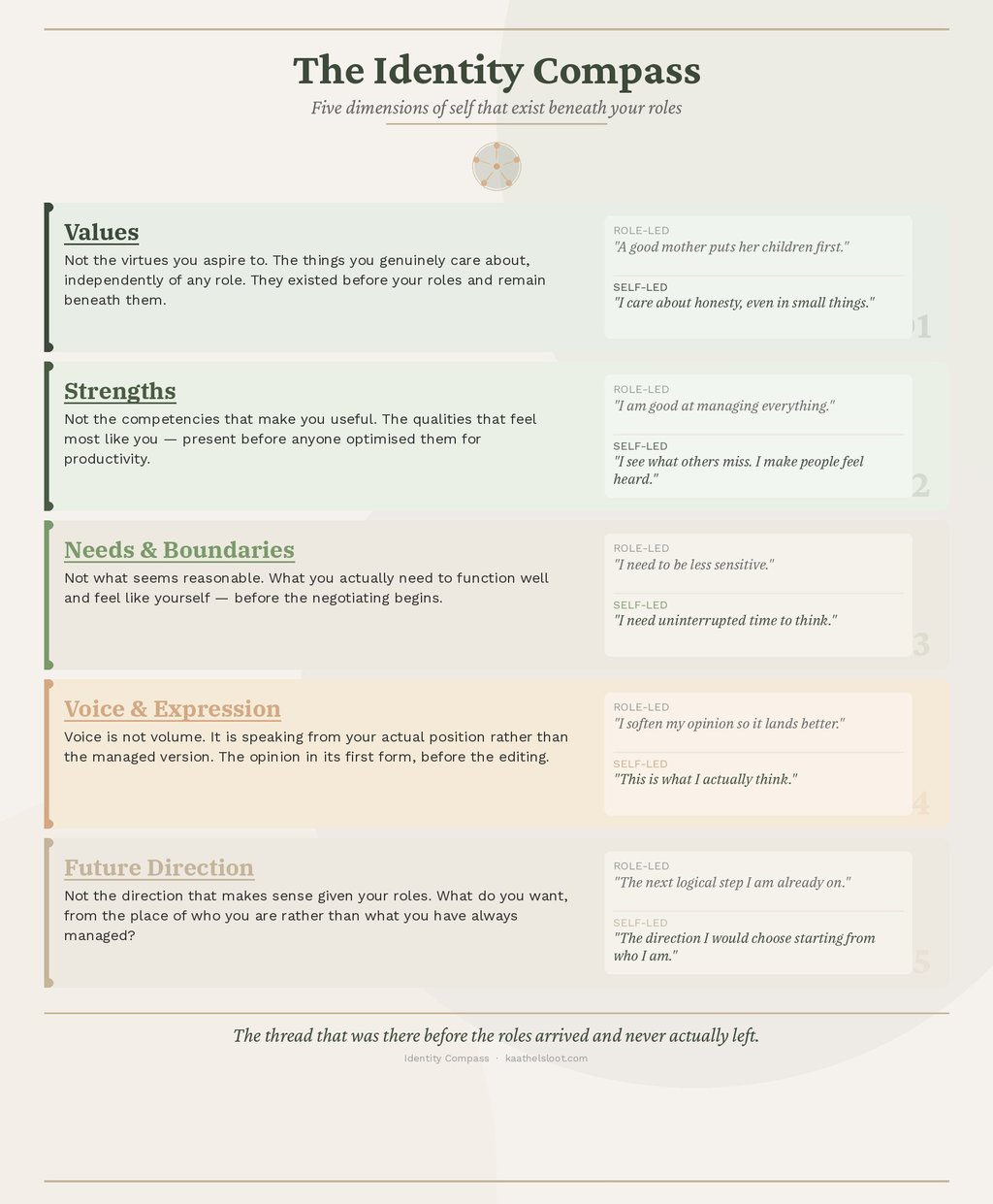
The Identity Compass I use in my work with women maps five dimensions of identity that exist independently of any role. Not who you are as a mother, a professional, a partner. Who you are beneath all of that. The thread that was there before the roles arrived and remains, compressed but present, underneath the accumulated weight of performing them.
These five dimensions are not abstract. They are practical and specific. And working through them honestly tends to produce the same response from almost every woman: a mixture of recognition and disorientation. Recognition because these things were never entirely gone. Disorientation because she had not been asked about them in a very long time.
Dimension 1: Values
Not the virtues you aspire to. Not what a good mother or a good professional does. But the things you genuinely care about, independently of any role or relationship. The orientations that shape how you respond to the world even when nobody is watching.
The distinction matters because role-based values sound like this: being a good mother means putting my children first. Self-based values sound like this: I care about honesty, even in small things. Or: fairness. I notice injustice before I notice almost anything else. Or: beauty. In spaces, in work, in how things are done.
Values do not require a role to exist. They existed before your roles. They are still there. But for many women who have spent years organised around what roles require, they have stopped being consulted.
Dimension 2: Strengths
Not the competencies that make you useful to other people, though those are real. The qualities that feel most like you. The ones that were present in childhood before anyone had optimised them for productivity. The way you think, the way you connect, the way you approach problems that is distinctly and recognisably yours.
Many women have a highly developed awareness of their functional strengths and very little awareness of the qualities beneath them. Knowing the difference is the beginning of leading from who you are rather than from what you produce.
Dimension 3: Needs and Boundaries
Not what seems reasonable given the circumstances. Not what is appropriate given everything else that is going on. What you actually need to function well and feel like yourself.
This dimension is often the most confronting for capable women because having needs has been, implicitly or explicitly, associated with weakness or inconvenience. The result is a long habit of minimising, deferring and absorbing. Of deciding that what you need is not the priority, until you have lost reliable contact with what that is.
Genuinely knowing your needs, not the negotiated, reasonable version but the actual ones, is what makes it possible to set limits that come from self-respect rather than from exhaustion.
Dimension 4: Voice and Expression
This is where taking leadership of your own life lives most directly.
Voice is not volume. It is the quality of speaking from your actual position rather than from the managed version of it. It is the opinion expressed in its first form rather than the edited one. It is the thing you say when you stop calculating whether it will be received well and simply say what is true for you.
For most women who have been performing roles rather than self-led living, the voice that emerges when the editing stops is surprising. Not because it is different from who they are. Because it is so much more clearly who they are than the version they have been presenting.
The return to voice does not require becoming louder or harder. It requires stopping the automatic editing long enough to hear what the unedited version actually is.
Dimension 5: Future Direction
Not the direction that is logical given your current roles and responsibilities. Not the next step that makes sense on the trajectory you are already on. What direction do you actually want to move in, from the place of who you are rather than what you have always managed to do?
This question tends to produce either clarity or blankness, depending on how long the self has been set aside. For women who have been leading from role for years, the idea of a direction that is genuinely their own can feel almost inaccessible. Not because it does not exist. Because the habit of orienting toward what is needed rather than what is wanted has been so complete for so long.
From role-led to self-led
The shift from role-led to self-led living is not a single moment. It is a reorientation. A gradual turning of the internal compass from what is needed of me to what is true for me, and how do I act from that truth in a way that honours my commitments without being consumed by them.
It begins with these five dimensions. Not as a theoretical exercise but as an honest inventory of what is actually there, beneath the roles, when you stop describing yourself in terms of what you do for other people.
The woman who knows her values and leads from them rather than from role requirements. The woman who speaks from her actual position rather than the edited version. The woman who knows what she needs and names it rather than absorbing the cost of not having it. That woman is not a different person. She is the same person with less editing in the way.
The free Identity Compass in my Toolbox for Women maps all five dimensions for you in around fifteen minutes. It is the starting point for this work and a resource you can return to as things shift. You will find it in the Toolbox for Women.
If this newsletter is useful to you, share it with a woman who has been performing herself for long enough.
With Warmth,
Kaat
Subscribe to my newsletter
Reflections on identity and responsibility
From time to time I write essays about identity, motherhood, responsibility and reconnecting with yourself.
If these themes resonate with you, you are welcome to join the newsletter.